


PRODUCTS
NEWS
- Advantages of High-Temperature Microwave Heating
- Shijiazhuang Hongtao Technology Launches Advanced Wood Drying Room for Energy-Saving Production
- Title: Shijiazhuang Hongtao Technology Wood Dryer Finds Use Across Industries
- 专业的电池正负极材料高温碳化微波焙烧炉辊道窑哪家好
- 好用的电池正负极材料高温碳化微波焙烧炉辊道窑耐用的生产厂家
Contact us
Contacts:liu
Mobile:+86-15631158838
Tel:+86-15631158838
E-mail:zekun1985@126.com
Add:No. 3, Xu Road, Leping, Xiping, Zhengding, Shijiazhuang, Hebei Province

The process of sintering gemstones in high-temperature oxidation furnace and roller kiln
Column:High temperature sintering furnace
Date:2026-01-12
Visits:16
Desc:The process of sintering gemstones in high-temperature oxidation furnace and roller kiln
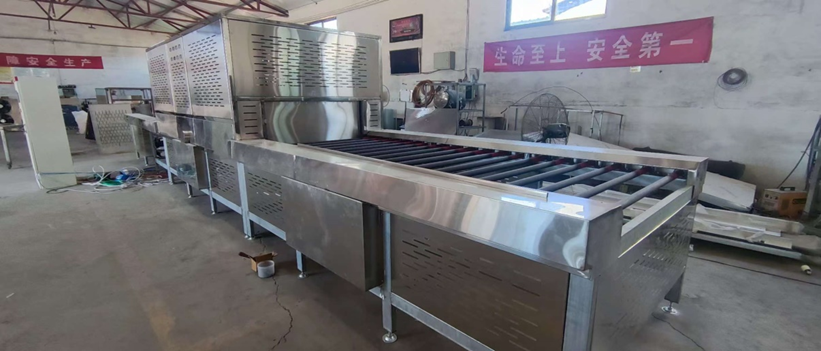
High-temperature oxidation furnace roller kiln is a continuous high-temperature sintering equipment. With the advantages of precise temperature control, stable oxidizing atmosphere, and continuous production, it has become the core equipment for gemstone (such as alumina corundum gems, spinel gems, etc.) sintering. Its complete process flow can be divided into five key links: raw material pre-treatment, loading and feeding, segmented high-temperature sintering, cooling and shaping, and post-processing inspection, as follows:
1. Raw Material Pre-treatment: Laying the Foundation for Gemstone Quality
First, the gemstone powder raw materials (such as high-purity alumina powder, spinel powder) are purified to remove impurities (to avoid discoloration and bubbles after sintering); then, according to the gemstone forming requirements, an appropriate amount of binder is added, and the gemstone green body is formed through pressing or casting processes; finally, the green body is subjected to low-temperature drying (temperature controlled at 120-200℃) to thoroughly remove moisture and volatile components of the binder, preventing cracking and deformation of the green body during high-temperature sintering.
2. Loading and Feeding: Adapting to Continuous Production Rhythm
After drying, the gemstone green bodies are neatly placed on high-temperature resistant ceramic carriers (which need to be compatible with the green body material to prevent high-temperature adhesion). The roller kiln conveying system is started, and the carriers are smoothly sent into the kiln furnace through the uniform rotation of high-temperature resistant roller rods. This link needs to ensure uniform spacing of the green bodies to avoid uneven heat distribution during sintering, which may affect the color consistency of the gems.
3. Segmented High-Temperature Sintering: Core Oxidation Reaction Stage
The roller kiln furnace is divided into a preheating section, a high-temperature sintering section, and an insulation section according to temperature gradient. An oxidizing atmosphere is maintained throughout (by introducing clean air and controlling the oxygen concentration at 20%-21%) to ensure that the gems complete crystal growth in an oxidizing environment:
◦ Preheating Section (Temperature 300-800℃): The green body is slowly heated, residual trace binders are completely volatilized, the green body is preliminarily hardened, and preparations are made for high-temperature sintering.
◦ High-Temperature Sintering Section (Temperature 1200-1800℃, adjusted according to gemstone varieties): This is the key step determining the density and crystallinity of the gems. Under high temperature, the powder particles of the green body undergo diffusion and rearrangement, gradually forming a dense crystalline structure; the oxidizing atmosphere can inhibit reducing impurities in the powder, ensuring the purity of the gem color (such as alumina corundum gems forming transparent colorless or colored crystals in this stage).
◦ Insulation Section (Temperature stabilized at the sintering peak, duration 2-6 hours): Maintaining high temperature allows crystals to grow fully, eliminating internal pores and defects, and improving core indicators such as gem hardness and transparency. The roller speed can precisely control the dwell time of the green body in the insulation section, adapting to the sintering requirements of different gems.
4. Cooling and Shaping: Avoiding Thermal Shock Cracking
After insulation, the gem green bodies are conveyed to the kiln cooling section with the roller rods. A stepwise cooling process is adopted: first, slow cooling in the 800-1000℃ range (cooling rate controlled at 50-100℃/h) to avoid thermal stress cracking caused by rapid cooling of high-temperature green bodies; then natural cooling to room temperature in the ambient temperature zone, allowing the gem crystal structure to stabilize and solidify.
5. Post-Processing Inspection: Producing Qualified Gem Finished Products
After cooling, the gem blanks need to undergo grinding, polishing, cutting, and other processes to be processed into qualified gem finished products; finally, professional equipment is used for inspection: checking the color uniformity, internal defects, hardness (such as corundum gems requiring a hardness of Mohs 9), transparency, and other indicators of the gems. Only qualified products can be warehoused.
Process Core Control Points
• Atmosphere Precise Control: Oxidizing Atmosphere
- UP:Mesh belt sintering furnace: Continuous and efficient industrial heat treatment core equipment
- NEXT:Microwave Sintering Furnace Technology
Recommend
-
Microwave Sintering Furnace Technology
-
The process of sintering gemstones in high-temperature oxidation furnace and roller kiln
-
Mesh belt sintering furnace: Continuous and efficient industrial heat treatment core equipment
-
Silicon Carbide High-Temperature Sintering: Unlocking the High-Performance Code of Special Materials